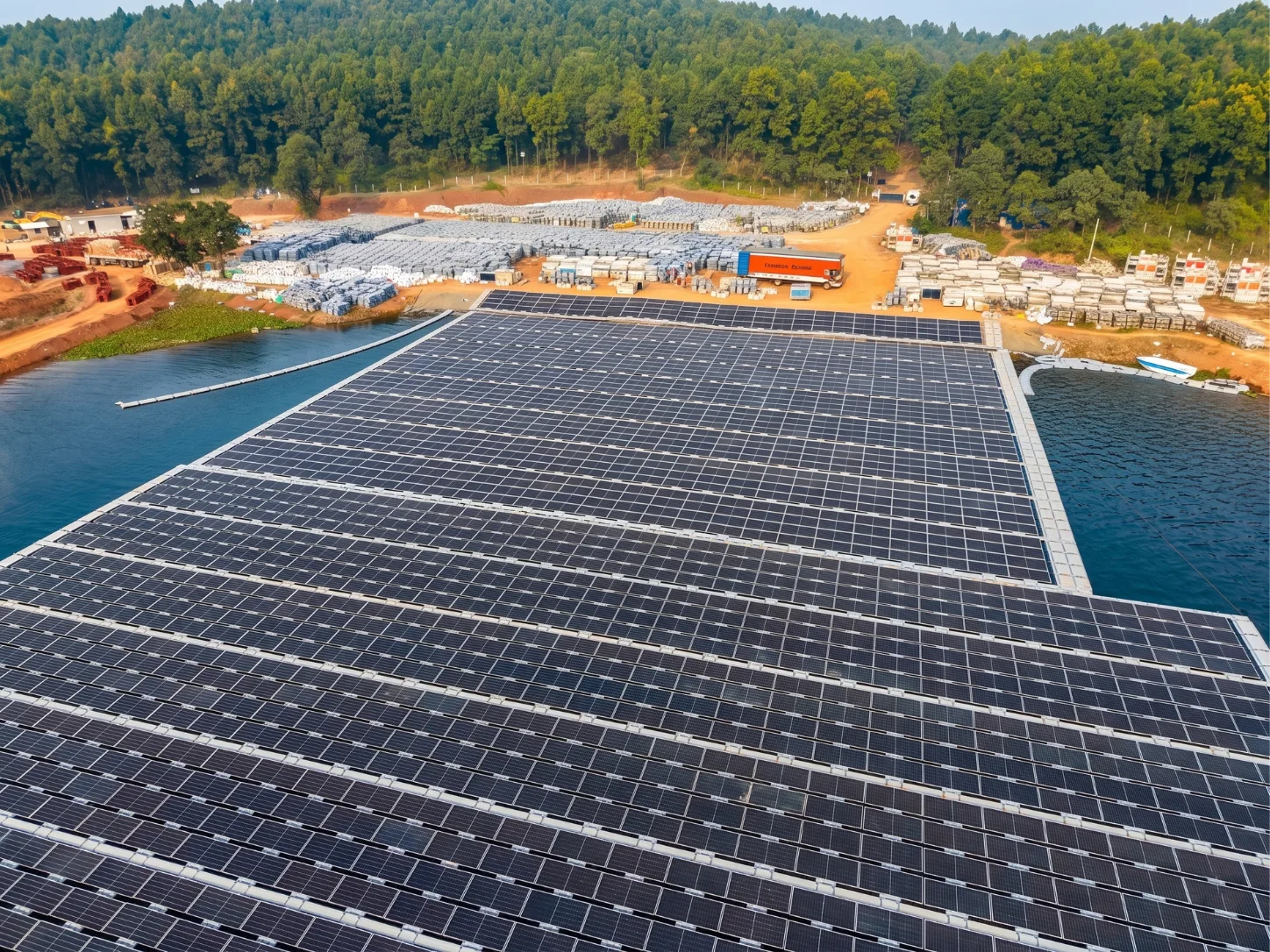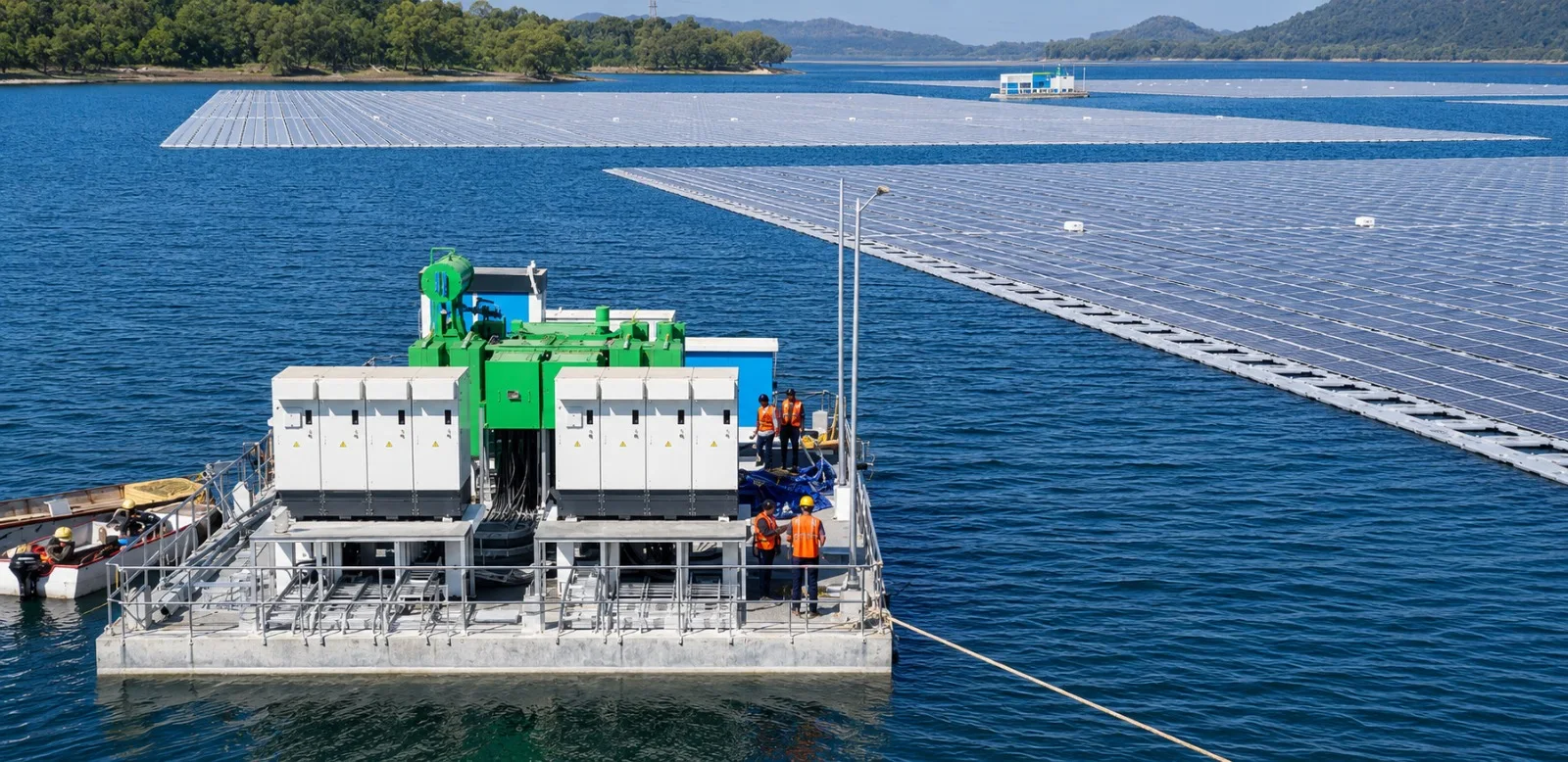
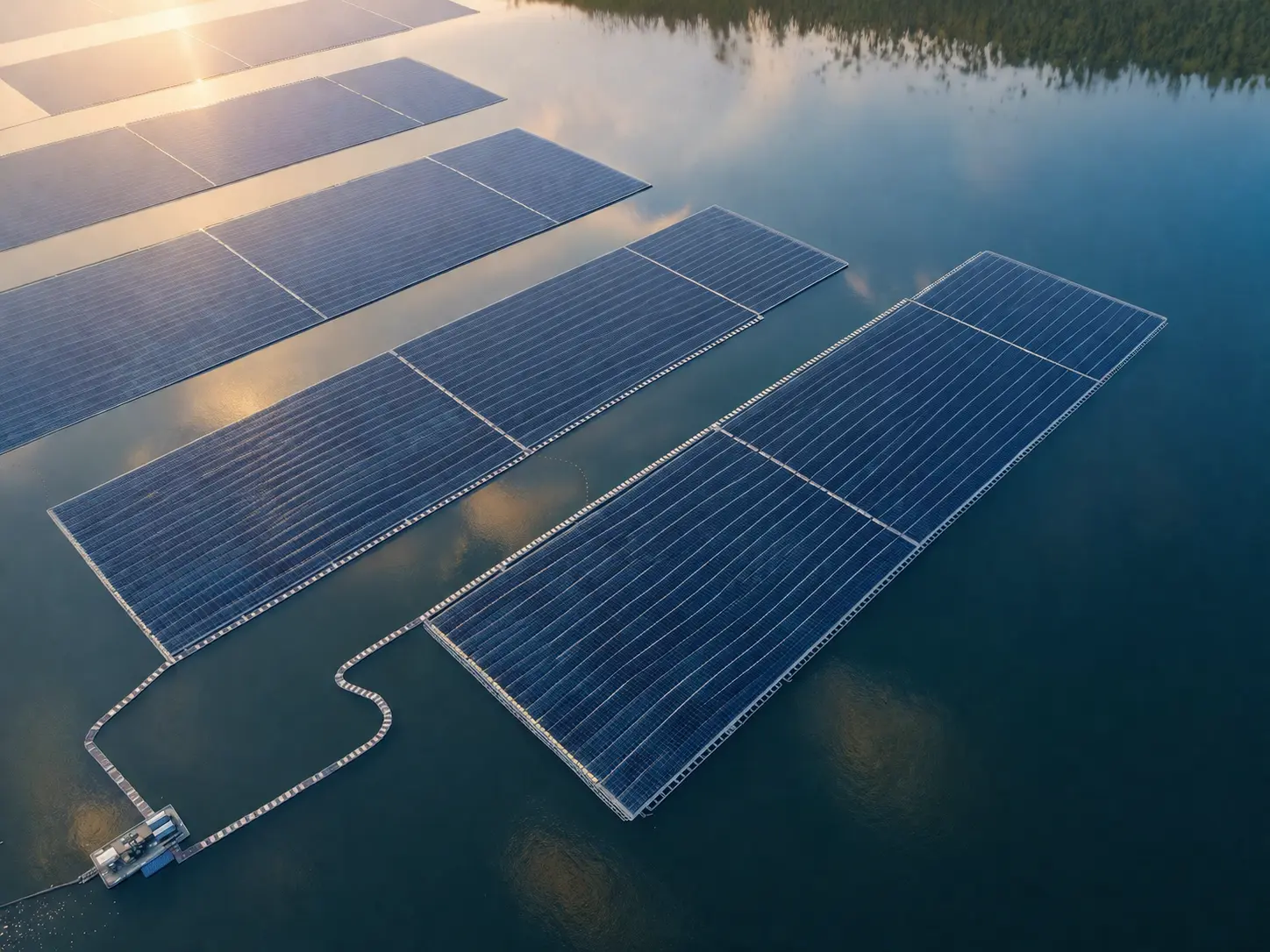
A floating solar plant isn't commercially operational simply because the last island has been built. Before it can be accepted by the grid, the complete system - islands, anchoring, cables, inverters, transformers, protection, SCADA, metering and evacuation - has to prove it can operate as one integrated whole. That proof is what Floating Solar Testing and Commissioning is for.
Ask most EPC teams when commissioning begins and they'll point to the day the last float is bolted into place. That answer works for a rooftop system. It doesn't work for a 100 MW–plus floating array spread across a reservoir, built in blocks over many months, sitting on a surface that moves. By the time a plant that size is “finished,” the earliest blocks may have been sitting energised, or waiting to be - for the better part of a year. Waiting until everything is physically complete to start testing anything electrical isn't caution; it's a scheduling risk dressed up as caution.
That's the thinking behind how we sequence commissioning at Floatex Solar. Rather than treating it as a single event at the end of construction, we treat it as a parallel track that runs alongside the build: mechanical checks, cabling continuity and insulation tests, inverter checks and power-quality verification, carried out progressively as each block becomes available, not held back until the whole plant is standing.
The Principle
The plant doesn't need to be finished to start proving itself. It needs each block to prove itself as it's finished - that's what keeps a multi-block build on schedule.
Commissioning starts before energisation
Floating solar commissioning has several dimensions that ground-mounted PV simply doesn't. An FPV system needs project-specific acceptance criteria to confirm the shape of the floating island and how the mooring lines respond as water levels change - which is what makes Floating Solar Testing and Commissioning fundamentally different from commissioning a conventional plant.
Before energisation, our checks typically cover:
- Float and walkway assembly
- Fasteners, locking arrangements and module mounting
- Array alignment and freeboard
- Mooring-line condition and installation
- Anchor positions and connections
- Cable support and strain relief
- Shore-transition arrangements
- Earthing and bonding
- DC polarity, continuity and insulation resistance
- Inverter, transformer and switchgear readiness
- SCADA (Supervisory Control and Data Acquisition), weather instruments and communication links
The goal isn't just to confirm every component has been installed - it's to verify that the interfaces between those components behave as intended.
From mechanical completion to COD
The path to commercial operation can be thought of as a series of acceptance gates:
| Stage | What we verify | Why it matters |
|---|---|---|
| Mechanical completion | Floats, modules, walkways, mooring and anchors | Confirms the floating system is assembled to the approved design |
| Electrical pre-commissioning | Cables, insulation, polarity, earthing and equipment | Finds installation defects before energisation |
| Block energisation | Inverters, transformers, protection and feeders | Tests each electrical section progressively |
| Control-system testing | SCADA, telemetry, alarms, PPC and communications | Confirms the plant can be monitored and controlled |
| Grid-interface testing | Protection, metering, voltage/reactive-power functions | Demonstrates compatibility with the network |
| Trial run | Generation and communication under operating conditions | Demonstrates plant operation before COD |
| Handover | As-builts, test records, punch-list closure and O&M baseline | Transfers a documented operating asset |
Because large floating projects are built in blocks, this staged approach is essential. Without it, a lengthy electrical verification process would otherwise have to wait until every island on the project has been physically completed.
Testing the floating system itself
Commissioning tends to focus heavily on electrical generation, but the floating platform itself needs its own clearly defined acceptance criteria just as much. A complete Floating Solar Testing and Commissioning strategy covers both structural verification and electrical performance.
Each completed island is assessed for its location, access routes and mooring system, which must hold the island in the correct position without straining the structure or the electrical system.
Array movement affects several other systems, mooring verification most of all. A poorly installed line can shift an island's position, distort the line's shape, or change the spacing between adjacent islands.
This stage also gives us the chance to build an initial mechanical record - anchor positions, mooring configuration, array location, and photographs of critical interfaces - that becomes part of the plant's baseline documentation.
Electrical testing moves from component to system
Once the mechanical structure is complete, electrical commissioning progresses from individual circuits to plant-wide operation. Cable continuity and insulation tests confirm circuit integrity before energisation; inverters are checked for correct function and communication; and as more of the plant comes online, transformers, switchgear and protection schemes - often mounted on ferrocement utility barges - are progressively brought into service.
Floating solar adds a question ground-mounted plants don't have to answer: how do you manage cables on an array that moves? Cable loops, support points and shore transitions all need to allow controlled movement without abrasion, excessive bending, or stress at termination points.
The IEA PVPS Review of Floating PV identifies movement, moisture, corrosion, water exposure and accessibility as the main factors that affect FPV reliability compared with ground-mounted systems - which is exactly why commissioning is the first real opportunity to confirm that the electrical installation performs as designed within this mechanical environment. Effective Floating Solar Testing and Commissioning is what turns that confirmation into documented confidence ahead of commercial operation.
Protection, SCADA and control are part of acceptance
A utility-scale plant is only accepted once its inverters demonstrate they can actually produce electricity - and once its protective relays operate in coordination with one another, as required under the Indian Electricity Grid Code for grid-connected users.
Before commercial operation, we also verify the control layer:
- SCADA data and alarms
- Inverter communication
- Revenue and interface metering
- Power Plant Controller functions
- Telemetry to the required control centre
- Active-power commands
- Voltage, power-factor and reactive-power control
- Weather and irradiance measurements
Typical performance tests for non-synchronous solar generation include real and reactive power capability, Power Plant Controller operation, and frequency response to set-point changes in active and reactive power. A plant that can't communicate, respond to control commands, or isolate faults isn't yet fit to operate on the grid - which is why these checks are such a central part of Floating Solar Testing and Commissioning.
The trial run connects commissioning with commercial operation
The formal trial run sits between commissioning and the declaration of commercial operation for solar plants connected to the IEGC. It's considered successful if power transmission and communication signals are sustained for at least four hours a day, from sunrise to sunset, with metering, the Power Plant Controller, telemetry and protection all running - with output measured against the solar radiation, temperature and other design conditions on the day.
The regulation also allows for phased trial runs on larger plants, and recognises that some demonstration requirements can't always be met on the day of testing (insufficient solar radiation, for instance) - in which case they can be demonstrated later. Once the trial run is complete and the test report submitted, the project moves to the declaration of COD under the relevant grid and PPA regulations.
Performance testing is not the same as energisation
Exporting power for the first time proves the plant can put electricity onto the grid; it doesn't on its own prove the system meets its contractual performance requirements. Depending on the contract, acceptance can also involve performance guarantee testing, proving of plant capacity, power quality testing, availability requirements and reliability testing. Performance guarantee testing, for instance, falls under the EPC and O&M scope of NTPC's solar procurement documents.
That distinction matters: energisation, commissioning, the trial run, and contractual acceptance and COD are separate processes, each with its own criteria. Floating Solar Testing and Commissioning is what documents each of these stages on the way to final contractual acceptance and commercial operation.
Handover should preserve what commissioning learned
Before our site crew demobilises, the data gathered during commissioning is put to work for operations. The handover package includes as-built drawings, test reports, equipment data, protection settings, SCADA data, mooring and anchorage data, outstanding punch-list items and inspection baselines.
For Floatex Solar, operational readiness comes from progressive testing, final inspection, compliance verification, as-built documentation and a proper transfer of information to the operating crew. Construction doesn't end at completion - commissioning is the first documented operational phase of the plant, not the last step of building it.
Only once every system - mechanical, electrical, control and grid-facing - can be shown to work together is a utility-scale FPV plant ready for commercial operation. Floating Solar Testing and Commissioning provides the foundation for that proof.
Key takeaways
Key Takeaways
- Commissioning should start block by block, alongside construction, not as a single event after the last island is installed.
- Floating platforms need their own acceptance criteria - array shape, freeboard and mooring response - in addition to standard electrical checks.
- Energisation, the trial run, and contractual COD are three separate milestones, each with its own pass/fail criteria.
- The handover package is the plant's operating memory: as-builts, test data, protection settings and mooring records all travel with the asset, not just the crew.
Questions we're commonly asked
How early can commissioning realistically start on a large floating project?
As soon as the first block has floats, mooring, cabling and an inverter in place, it can go through mechanical and electrical pre-commissioning checks, well before the rest of the plant exists. On multi-block projects this is normally the difference between a commissioning programme measured in weeks versus months tacked onto the end of construction.
Does a fast trial run mean the plant is fully accepted?
No, a successful trial run demonstrates the plant can generate and communicate reliably; it doesn't by itself satisfy contractual performance guarantees, capacity proving, power-quality testing or availability requirements, which are typically assessed separately and can extend well beyond COD.
What's genuinely different about commissioning a floating plant versus a ground-mounted one?
Two things mainly: the platform itself needs acceptance criteria (array alignment, freeboard, mooring-line behaviour as water levels change) that a ground-mounted plant never has to demonstrate, and every cable route has to tolerate ongoing movement rather than staying fixed, which changes how continuity, strain relief and abrasion are checked and re-checked over the plant's life.
What happens if solar radiation on the day of the trial run is poor?
The regulatory framework anticipates this. Provisions exist for phased trial runs on larger plants, and demonstration requirements that can't be met on a low-irradiance day can be carried out and demonstrated later rather than failing the plant outright.
The common thread through all of this is documentation. A trial run that succeeds but isn't recorded properly, or a mooring adjustment made during commissioning that never makes it into the as-builts, quietly becomes next year's O&M problem. Getting Floating Solar Testing and Commissioning right isn't only about passing each gate - it's about making sure the plant that goes into commercial operation is the one that's actually on paper.