
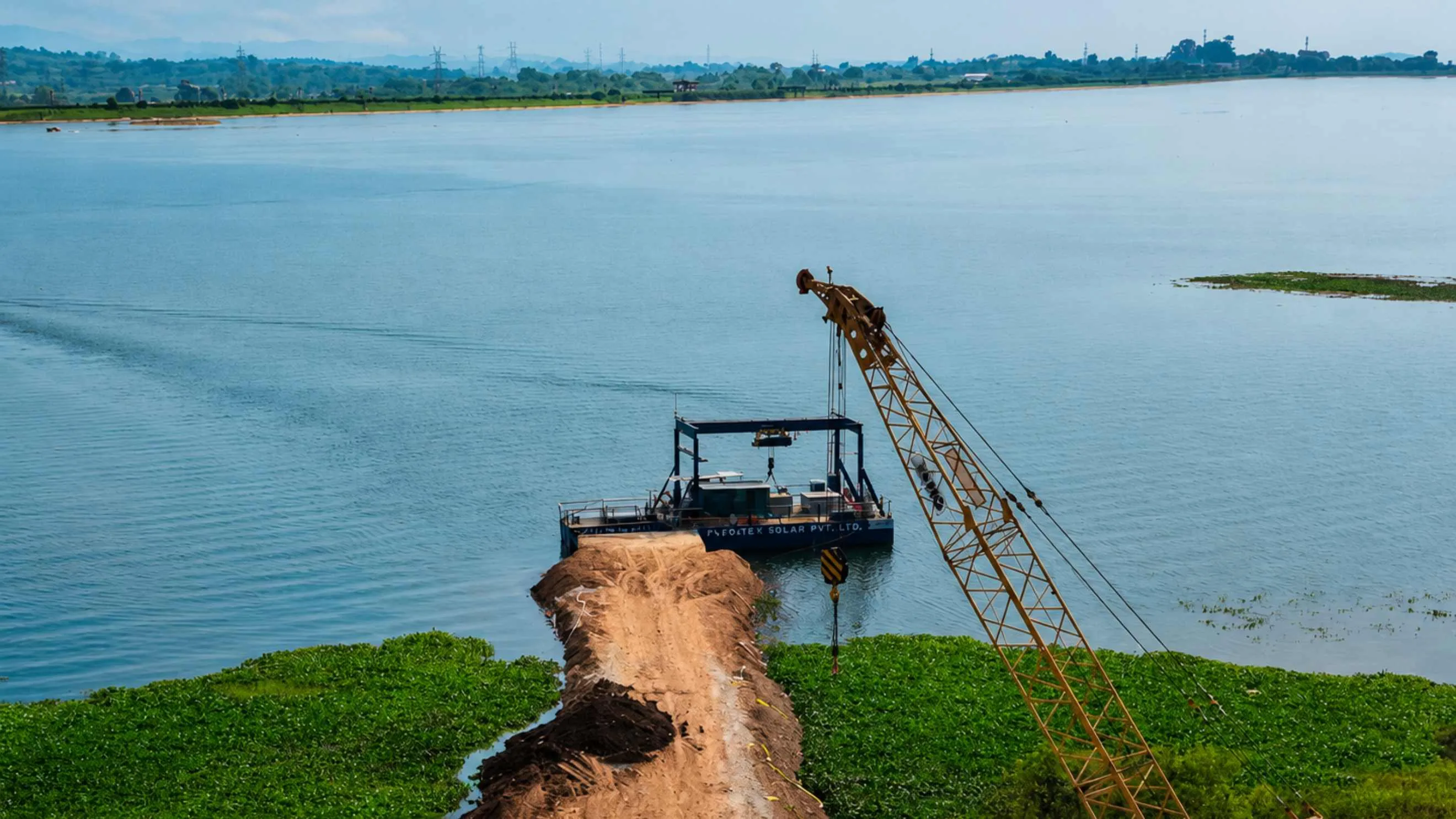
Built on water.
Powering the nation.
From reservoirs to canals - every installation engineered for maximum yield, minimum footprint.
14+ commissioned installations across India's major reservoirs.
13 MWp ONGC Hazira
Under Development
Gujarat, India
43 MWp Panchet Dam
NTPC GE
Jharkhand, India
24.3 MWp GAIL Pata
Purshotam Profiles Pvt Ltd
Uttar Pradesh, India
Floating Solar Projects -
Frequently Asked Questions
A floating solar project is a solar PV plant that uses a floating array of PV modules and associated infrastructure installed on a suitable water body instead of on conventional land-based foundations.
Reservoirs, dammed lakes, lakes, irrigation ponds, industrial water bodies, canals, and mine-related water bodies can all be considered for floating solar projects. A feasibility study is needed to assess the technical, environmental, and commercial suitability of the water body.
The capacity depends on the usable water surface area, exclusion zones, array density, module type, water-level behavior, wind/wave conditions, anchoring possibilities, grid capacity, environmental constraints, and project economics. Therefore, the entire water body is rarely available for solar installations.
The stages involved in a typical development include feasibility studies and surveys, preliminary engineering, detailed design, float and structural installation, anchoring and mooring, array installation, electrical installation, testing, commissioning, and handover. A floating solar EPC contractor can undertake one or more of these stages.
Examples of Floatex projects include NTPC Ramagundam, NTPC Kayamkulam, NTPC Simhadri, NTPC Kawas, and the Omkareshwar projects, developed in collaboration with AMP Energy and Tata Power.
The mooring system, anchorage geometry, cable routing, and access arrangements must account for the expected water-level range of the water body where the floating array will be installed.
Floating pontoons or modular floats support the solar modules and associated infrastructure. Their design should account for module configuration, walkways, mooring loads, maintenance requirements, and the electrical requirements of the solar PV system.
Heavier electrical equipment that needs to be installed on the water can be placed on a specially designed floating platform, such as a ferrocement barge. This helps ensure that the inverter, switchgear, transformer, and monitoring systems are properly integrated with the rest of the solar array.